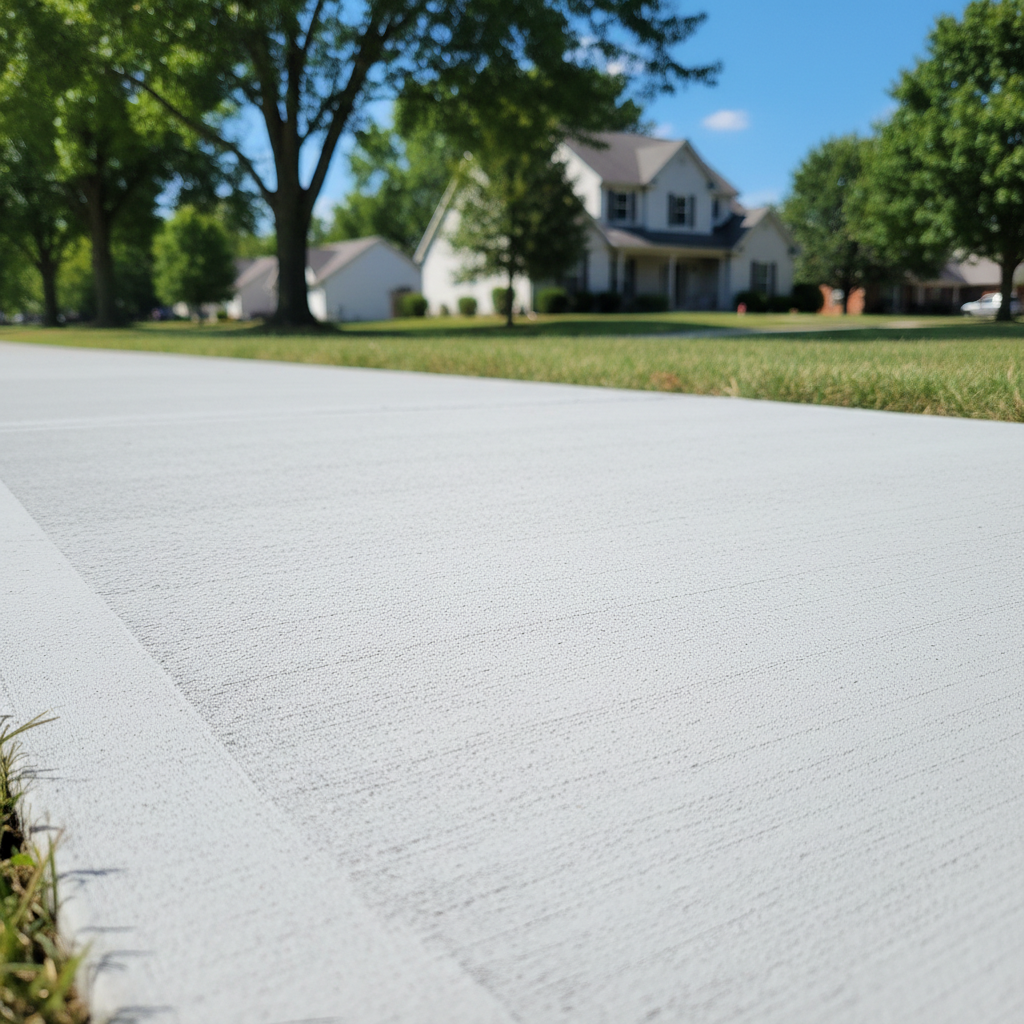
Why do concrete sidewalks crack, even new ones?
This is probably the most common question I hear, honestly. And here's the thing: concrete cracks. It's not really a matter of "if," but "when" and "how much." The biggest reason? Usually, it's expansion and contraction from temperature changes. Here in Lawrence, we get some pretty wild swings, don't we? Hot summers, freezing winters. When concrete heats up, it expands; when it cools, it shrinks. If it doesn't have room to move, stress builds up, and then it cracks. That's why we put in control joints – those lines you see cut into the concrete. They're designed to give the concrete a predictable place to crack, so you don't end up with ugly, random fractures all over the place. Poor sub-base preparation, too much water in the mix, or even tree roots can also play a role. Sometimes, it's just the ground settling underneath, especially in areas with a lot of clay soil like we have around here.
How long should a concrete sidewalk last?
A well-installed concrete sidewalk, if you maintain it properly, should last you a good 20 to 30 years. Sometimes even more! I've actually seen some sidewalks around Old West Lawrence that are still holding up after 50 years, though they might be showing their age a bit. The lifespan really depends on a few things: the quality of the concrete mix, how well the base underneath was prepared, how it was cured, and how much abuse it takes. Heavy foot traffic, constant freezing and thawing cycles, and even de-icing salts can shorten its life. If you're seeing significant spalling (that's surface flaking) or large, uneven cracks after only a few years, something probably wasn't done right during installation.
Can you repair a cracked or uneven sidewalk, or does it need to be replaced?
It really depends on how bad it is. Small, hairline cracks? You can often seal those up to stop water from getting in and making them worse. If a section is just a little uneven, sometimes we can do what's called 'slab jacking' or 'mudjacking' – basically, we pump a material underneath to lift and level it. It's a lot less invasive and cheaper than tearing everything out and replacing it. But if you've got large, structural cracks running all the way through, or if sections have heaved significantly, or if the concrete is crumbling and spalling badly, replacement is usually the better, more long-term solution. Trying to patch really bad concrete is like putting a band-aid on a broken leg; it just won't hold up. I always tell folks, let's take a look. Sometimes it's an easy fix, other times it's a bigger job.
What's the deal with those control joints? Are they really necessary?
Absolutely, they're necessary. I touched on this earlier, but it's worth going over again. Control joints, or contraction joints, are those grooves we saw-cut into the concrete. Their whole purpose is to create weakened planes where the concrete *can* crack when it shrinks. Without them, the concrete would just crack wherever it wants, usually in jagged, unsightly patterns. We typically cut them to a depth of about a quarter of the slab's thickness. You might also hear about expansion joints, which are different. Those are full-depth separations, often filled with a compressible material, placed where the sidewalk meets a house, a driveway, or another fixed structure. They allow for movement without pushing against those other elements. Both types of joints are critical for a long-lasting, good-looking sidewalk.
How much does a new concrete sidewalk cost in Lawrence?
This is a tough one to give a precise number without actually seeing the job, but I can give you a general idea. Costs depend on a few factors: the size (square footage), the thickness of the concrete, whether we need to remove old concrete, how easy it is to get to the site, and any special finishes you might want. Generally, you're looking at anywhere from $9 to $15 per square foot for a standard 4-inch thick sidewalk. If there's a lot of demolition, difficult access, or you want something like stamped concrete, that price can go up. For example, if we're doing a sidewalk through a tight backyard in a neighborhood like Pinckney, just getting materials in and out can add to the labor cost. Always get a detailed quote that breaks down materials, labor, and any demolition or prep work. That's what we do at Spectrum Concrete Solutions.
Can I pour a concrete sidewalk myself, or should I hire a pro?
Look, I'm all for DIY projects, but pouring concrete flatwork, especially a sidewalk that needs to look good and last, isn't as easy as it seems. There's a lot more to it than just mixing and pouring. You need to know about proper sub-base compaction, setting forms accurately, getting the right concrete mix, pouring it consistently, and then, crucially, finishing and curing it correctly. If you mess up the base, it'll crack prematurely. If you don't finish it right, it'll look like a lumpy mess or spall quickly. If you don't cure it properly, it won't reach its full strength. For a small, out-of-the-way pad, maybe. But for your main sidewalk that people walk on every day and that impacts your home's curb appeal, I really recommend hiring a professional. We've got the tools, the experience, and the know-how to make sure it's done right the first time.