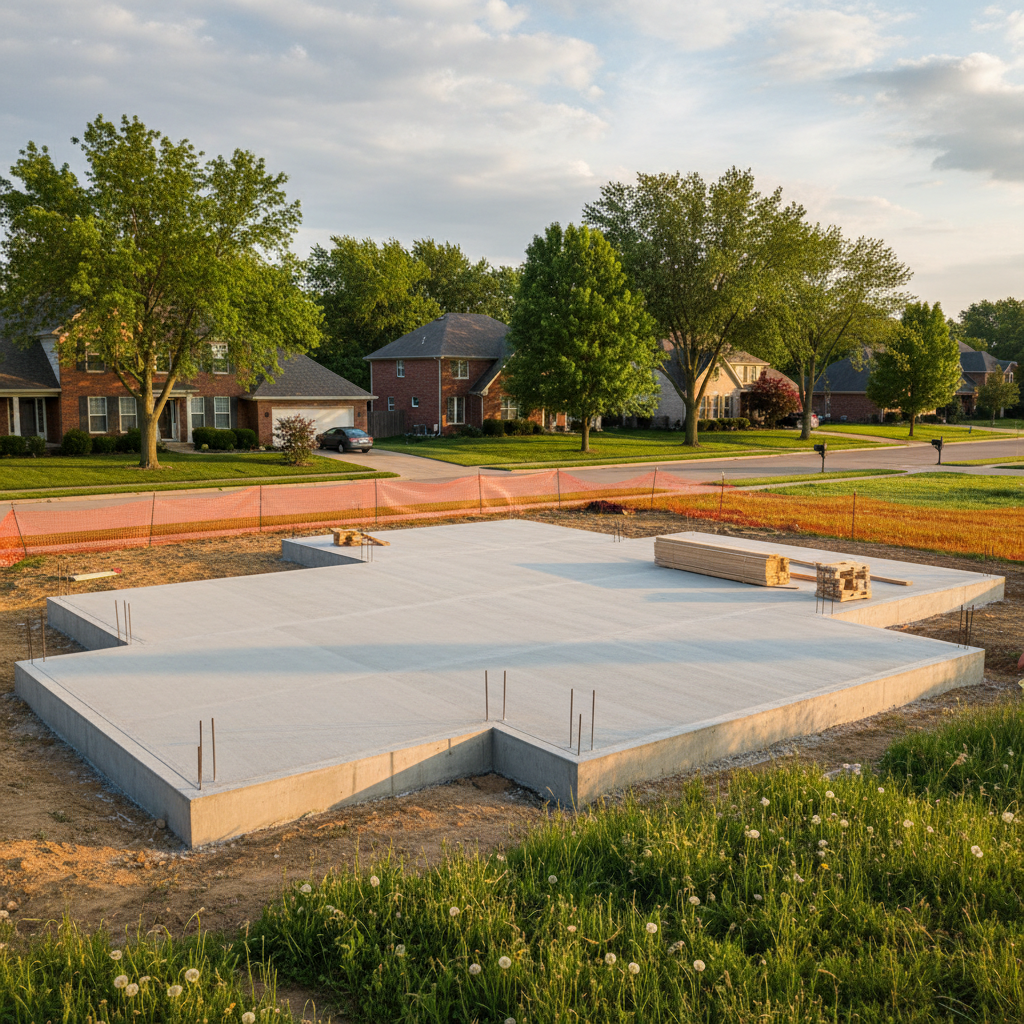
If you have spent any time digging a post hole in Old West Lawrence or trying to plant a garden out in West Lawrence, you already know the truth about our ground. It is heavy, sticky clay. That clay expands like a sponge when we get those heavy spring downpours, and then it shrinks right back up and cracks when July and August turn everything into dust.
That constant cycle of swelling and shrinking puts a massive amount of pressure on concrete foundations. Pouring a foundation here is not like pouring one out on sandy coastal soil or solid rock. You have to know how the ground behaves across Douglas County.
What Kansas Clay Does to a Foundation
Houses built on expansive clay take a beating over the years. When the dirt right up against your basement walls gets soaking wet, it swells up and pushes inward. When it dries out, it pulls away, leaving gaps. If a foundation pour is not reinforced properly with the right steel and depth, you will start seeing stair-step cracks running through the mortar or poured concrete sooner rather than later.
Spectrum Concrete Solutions sees what happens when shortcuts get taken during the excavation and prep stages. If you do not compact that sub-base thoroughly before the pour, the weight of the structure is going to settle unevenly.
- Expansive clay holds moisture and swells against basement walls
- Shallow limestone bedrock creates mixed-bearing pressure points
- Freeze-thaw cycles test every square inch of uninsulated or shallow footings
Building for the Long Haul in Douglas County
Getting a foundation right means respecting the local environment. North Lawrence sits down on the floodplain with a higher water table, which brings entirely different moisture challenges compared to the uplands near KU. You have to factor in proper drainage, thick gravel sub-bases, and the right concrete mix design to keep groundwater from seeping up through the slab.
Spectrum Concrete Solutions does not believe in generic fixes because every neighborhood from Clinton Parkway to downtown has its own quirks. Taking the extra time to grade properly, set solid forms, and use heavy steel reinforcement means you will not be dealing with shifting floors or leaking basement walls down the road. A solid house starts at the very bottom, and building it to withstand Kansas weather keeps your investment secure for 15 to 20 years or more.